From Offtakes to Infrastructure: A Healthier Earth on Financing Carbon Removal
What makes a carbon removal project truly financeable in today’s market? Dive into expert insights on de-risking project pipelines, attracting long-term institutional capital, and navigating the key financial bottlenecks shaping the next five years of CDR deployment.

From Offtakes to Infrastructure: A Healthier Earth on Financing Carbon Removal
What makes a carbon removal project truly financeable in today’s market? Dive into expert insights on de-risking project pipelines, attracting long-term institutional capital, and navigating the key financial bottlenecks shaping the next five years of CDR deployment.
What makes a carbon removal project truly financeable in today’s market? Dive into expert insights on de-risking project pipelines, attracting long-term institutional capital, and navigating the key financial bottlenecks shaping the next five years of CDR deployment.
What makes a carbon removal project truly financeable in today’s market? Dive into expert insights on de-risking project pipelines, attracting long-term institutional capital, and navigating the key financial bottlenecks shaping the next five years of CDR deployment.
What makes a carbon removal project truly financeable in today’s market? Dive into expert insights on de-risking project pipelines, attracting long-term institutional capital, and navigating the key financial bottlenecks shaping the next five years of CDR deployment.
What makes a carbon removal project truly financeable in today’s market? Dive into expert insights on de-risking project pipelines, attracting long-term institutional capital, and navigating the key financial bottlenecks shaping the next five years of CDR deployment.
What makes a carbon removal project truly financeable in today’s market? Dive into expert insights on de-risking project pipelines, attracting long-term institutional capital, and navigating the key financial bottlenecks shaping the next five years of CDR deployment.
What makes a carbon removal project truly financeable in today’s market? Dive into expert insights on de-risking project pipelines, attracting long-term institutional capital, and navigating the key financial bottlenecks shaping the next five years of CDR deployment.
What makes a carbon removal project truly financeable in today’s market? Dive into expert insights on de-risking project pipelines, attracting long-term institutional capital, and navigating the key financial bottlenecks shaping the next five years of CDR deployment.
What makes a carbon removal project truly financeable in today’s market? Dive into expert insights on de-risking project pipelines, attracting long-term institutional capital, and navigating the key financial bottlenecks shaping the next five years of CDR deployment.
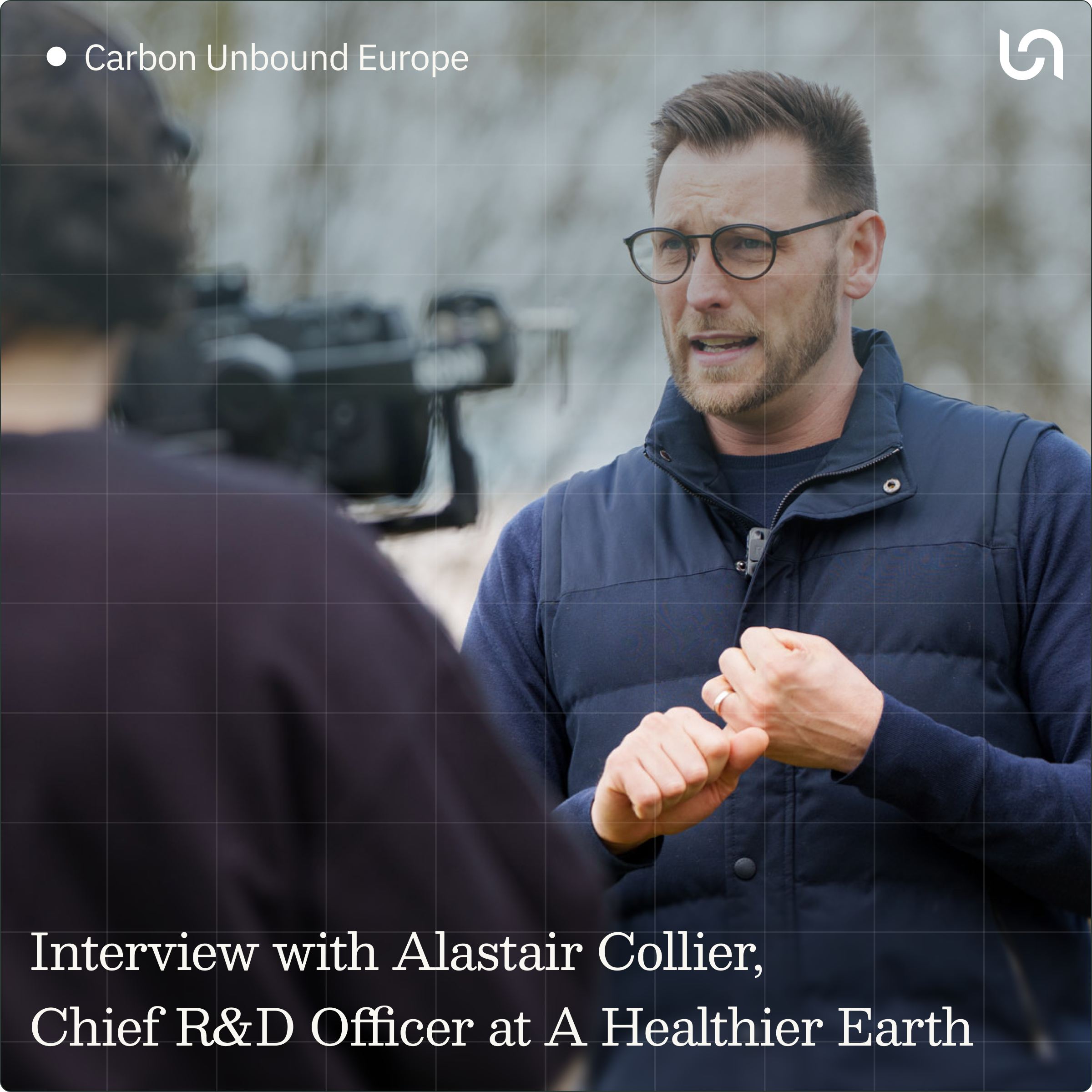
As the carbon removal sector matures, securing institutional finance remains one of its biggest hurdles. Ahead of Carbon Unbound Europe, we interviewed Alastair Collier, Chief R&D Officer at A Healthier Earth, about de-risking infrastructure, structuring bankable offtakes, and scaling investment in CDR. Here’s what he had to say.
What makes an offtake agreement truly bankable for CDR projects?
For me, it all comes down to being predictable. Investors are not looking for the most innovative climate projects; they are looking for confidence that a project will generate reliable cash flows over a period of time. Projects must offer clear delivery commitments, clear payment obligations, and a contract that is aligned with the rest of the project structure. If we want carbon removal to scale, we need to start thinking of offtakes as major infrastructure contracts, and not just climate agreements.
How important is long-term demand in unlocking investment in carbon removal?
Long-term demand is critical to unlocking investment, because we can offer the most groundbreaking technology in the world, but if there isn't confidence that demand will exist in five, ten or fifteen years, it's incredibly difficult to attract large-scale capital. Investors need assurance of future revenues, and long-term demand is what gives them that confidence and creates the conditions for projects to scale beyond pilots.
How long or how large does an offtake need to be to attract institutional capital?
There's no magic number, but it needs to reflect the realities of infrastructure investing. Most projects have payback periods that are significantly longer than the three-to-five-year contracts we often see today. If you want institutional capital, you need agreements that provide revenue visibility over a meaningful proportion of the asset life. The bigger point is not the exact number of years but giving investors’ confidence that revenues will be there when they need them.
What have you learned from developing CDR projects at A Healthier Earth?
The biggest lesson is that scale comes from commercial value. To deliver meaningful climate impact, we need to look beyond the climate story and focus on projects that clearly demonstrate business value. If customers, from farmers to urban planners, see real-world value, investors see returns and communities see benefits, then scale becomes achievable. That's really been the unlock for us.
What do lenders need to see before financing carbon removal infrastructure?
Lenders need to see that the fundamentals are in place to deliver robustly and at scale. That means secure feedstock, reliable technology, robust monitoring and reporting, clear delivery commitments, strong contracts and predictable revenue streams over an extended period of time.
They need assurance that a project can deliver what it says it will deliver, consistently and commercially. When those pieces come together, carbon removal starts to take on the characteristics of an infrastructure-grade asset class.
Where do investors and lenders still see the biggest risks in CDR?
The biggest concern is whether projects can move from promising individual developments to consistent delivery at scale. Investors are still cautious around technology performance, feedstock supply, project execution, revenue certainty and the strength of the overall contract structure. These risks are solvable, but they need to be addressed systematically through strong governance, repeatable delivery models and a clear route to scaling beyond single projects.
What needs to change for CDR financing to become more scalable?
We need to make carbon removal look and feel less like an early-stage climate venture and more like infrastructure projects that capital markets can underwrite. That means moving beyond demand signals alone and creating the contractual structures, risk allocation, delivery models and revenue visibility that allow institutional investors to assess biochar and wider CDR through familiar project finance principles. Successful infrastructure platforms bridge this gap by shifting focus from individual projects to repeatable execution.
What is A Healthier Earth currently working on to help move the sector forward?
We're building an integrated biochar carbon removal platform designed to help the sector move beyond standalone projects and towards repeatable, scalable delivery. By bringing together project development, due diligence, verification, and carbon credit delivery in a single platform, we're creating a model that can be deployed across multiple sites, partners, and geographies.
The aim is to reduce complexity and risk for both carbon credit buyers and investors. Just as mature infrastructure markets are built on standardised governance, processes and oversight rather than individual assets, our platform is designed to provide buyers with confidence in supply while giving investors exposure to a diversified portfolio of high-integrity biochar projects.
Alongside carbon removal, we're also focused on creating commercial markets for biochar, developing long-term customer demand and helping create the conditions for the industry to reach meaningful scale. Like our work with Cefetra, the UK AgriTech Centre and UKCEH to develop a biochar-based fertiliser for UK cereal farmers. Supported by a £1.34m DEFRA Farming Innovation Programme grant and delivered in partnership with Innovate UK, the project demonstrates how biochar can create value beyond carbon credits, helping reduce nitrogen use, improve soil health and unlock new commercial opportunities that support long-term industry growth.
What role can A Healthier Earth play in the development of a mature CDR market?
Our role is to demonstrate that carbon removal can be delivered in a way that is investable, repeatable and commercially viable. We're trying to bring together all the pieces that need to work in harmony: feedstock, technology, end markets, carbon credits, financing and community engagement. If we can show that model works, it becomes much easier for others to replicate and scale.
What would success look like for CDR financing over the next five years?
Success would be reaching a point where high-quality carbon removal projects are financed in the same way that other infrastructure projects are financed today. I'd like to see longer-term offtakes, greater participation from institutional investors and far more projects moving from development into operation. Ultimately, success is getting enough capital flowing into the sector that the challenge is no longer finding investors but delivering projects fast enough to meet demand. That, to me, is the challenge we want to have.
Learn more about A Healthier Earth.
.png)
As the carbon removal sector matures, securing institutional finance remains one of its biggest hurdles. Ahead of Carbon Unbound Europe, we interviewed Alastair Collier, Chief R&D Officer at A Healthier Earth, about de-risking infrastructure, structuring bankable offtakes, and scaling investment in CDR. Here’s what he had to say.
What makes an offtake agreement truly bankable for CDR projects?
For me, it all comes down to being predictable. Investors are not looking for the most innovative climate projects; they are looking for confidence that a project will generate reliable cash flows over a period of time. Projects must offer clear delivery commitments, clear payment obligations, and a contract that is aligned with the rest of the project structure. If we want carbon removal to scale, we need to start thinking of offtakes as major infrastructure contracts, and not just climate agreements.
How important is long-term demand in unlocking investment in carbon removal?
Long-term demand is critical to unlocking investment, because we can offer the most groundbreaking technology in the world, but if there isn't confidence that demand will exist in five, ten or fifteen years, it's incredibly difficult to attract large-scale capital. Investors need assurance of future revenues, and long-term demand is what gives them that confidence and creates the conditions for projects to scale beyond pilots.
How long or how large does an offtake need to be to attract institutional capital?
There's no magic number, but it needs to reflect the realities of infrastructure investing. Most projects have payback periods that are significantly longer than the three-to-five-year contracts we often see today. If you want institutional capital, you need agreements that provide revenue visibility over a meaningful proportion of the asset life. The bigger point is not the exact number of years but giving investors’ confidence that revenues will be there when they need them.
What have you learned from developing CDR projects at A Healthier Earth?
The biggest lesson is that scale comes from commercial value. To deliver meaningful climate impact, we need to look beyond the climate story and focus on projects that clearly demonstrate business value. If customers, from farmers to urban planners, see real-world value, investors see returns and communities see benefits, then scale becomes achievable. That's really been the unlock for us.
What do lenders need to see before financing carbon removal infrastructure?
Lenders need to see that the fundamentals are in place to deliver robustly and at scale. That means secure feedstock, reliable technology, robust monitoring and reporting, clear delivery commitments, strong contracts and predictable revenue streams over an extended period of time.
They need assurance that a project can deliver what it says it will deliver, consistently and commercially. When those pieces come together, carbon removal starts to take on the characteristics of an infrastructure-grade asset class.
Where do investors and lenders still see the biggest risks in CDR?
The biggest concern is whether projects can move from promising individual developments to consistent delivery at scale. Investors are still cautious around technology performance, feedstock supply, project execution, revenue certainty and the strength of the overall contract structure. These risks are solvable, but they need to be addressed systematically through strong governance, repeatable delivery models and a clear route to scaling beyond single projects.
What needs to change for CDR financing to become more scalable?
We need to make carbon removal look and feel less like an early-stage climate venture and more like infrastructure projects that capital markets can underwrite. That means moving beyond demand signals alone and creating the contractual structures, risk allocation, delivery models and revenue visibility that allow institutional investors to assess biochar and wider CDR through familiar project finance principles. Successful infrastructure platforms bridge this gap by shifting focus from individual projects to repeatable execution.
What is A Healthier Earth currently working on to help move the sector forward?
We're building an integrated biochar carbon removal platform designed to help the sector move beyond standalone projects and towards repeatable, scalable delivery. By bringing together project development, due diligence, verification, and carbon credit delivery in a single platform, we're creating a model that can be deployed across multiple sites, partners, and geographies.
The aim is to reduce complexity and risk for both carbon credit buyers and investors. Just as mature infrastructure markets are built on standardised governance, processes and oversight rather than individual assets, our platform is designed to provide buyers with confidence in supply while giving investors exposure to a diversified portfolio of high-integrity biochar projects.
Alongside carbon removal, we're also focused on creating commercial markets for biochar, developing long-term customer demand and helping create the conditions for the industry to reach meaningful scale. Like our work with Cefetra, the UK AgriTech Centre and UKCEH to develop a biochar-based fertiliser for UK cereal farmers. Supported by a £1.34m DEFRA Farming Innovation Programme grant and delivered in partnership with Innovate UK, the project demonstrates how biochar can create value beyond carbon credits, helping reduce nitrogen use, improve soil health and unlock new commercial opportunities that support long-term industry growth.
What role can A Healthier Earth play in the development of a mature CDR market?
Our role is to demonstrate that carbon removal can be delivered in a way that is investable, repeatable and commercially viable. We're trying to bring together all the pieces that need to work in harmony: feedstock, technology, end markets, carbon credits, financing and community engagement. If we can show that model works, it becomes much easier for others to replicate and scale.
What would success look like for CDR financing over the next five years?
Success would be reaching a point where high-quality carbon removal projects are financed in the same way that other infrastructure projects are financed today. I'd like to see longer-term offtakes, greater participation from institutional investors and far more projects moving from development into operation. Ultimately, success is getting enough capital flowing into the sector that the challenge is no longer finding investors but delivering projects fast enough to meet demand. That, to me, is the challenge we want to have.
Learn more about A Healthier Earth.
.png)
.png)


.webp)