




London Climate Action Week 2026
London Climate Action Week has grown into a behemoth of a meeting, becoming the 2nd largest climate week after New York with over 100,000 attendees. It's a migration of climate professionals, flocking from all over the world to England’s capital for a week of 1000s of free-to-attend and closed-door meetings put on by all sorts of companies and organisations. Even those not focused on climate are being drawn into its orbit as it starts to affect every industry and corner of the globe. We felt this as temperatures rose to 40 degrees across London.
Just comparing it to the year prior, the number of CDR-focused events and onstage mentions had notably increased. More fringe topics within the removals sphere, like methane abatement, had dedicated events with strong attendance. Among the backdrop of the current political, economic and industry-specific pessimism, it is easy to feel like we’re moving backwards. But gatherings like these bring a sense of grounded realism and remind us of the progress being made. Some, of course, can be echo chambers, but others stimulate thoughtful debate and push those on both extremes to come away with different perspectives. If nothing else, these climate weeks illustrate one thing; there are 100,000s of intelligent and diligent individuals working on solving this problem. Things aren’t always moving quick enough, but they are moving in the right direction.
June and July acts as a short ‘break’ from the Carbon Unbound event calendar before the pressure of delivering Europe sets in (although some of the team may not agree). The company took our chance to take off our organiser hats and enjoy just being attendees. To the event organisers, those who we saw hurrying across venue stages and exhibition floors with a calm facade, feeling the rising stress of finding the next speaker or making sure the reception break was running on time, we salute you.
We’ve compiled the team’s takeaways from hours of sessions and interactions. For those that are looking for their next CDR event, we invite you to Carbon Unbound Europe in October to reconnect and share progress.

Summarised takeaways
(Event summaries below)
Policy & Compliance
- EU ETS review lands 15 July. One of the key design questions is centralised buyer intermediary vs. direct procurement.
- Political momentum can reverse overnight, as seen in the US DAC hub u-turn. Don't plan around policy permanence.
- The threat of regulation moves markets more than regulation itself. NYC's Local Law 97 reshaped real estate before it even bit.
Market Dynamics
- Quality is beating price. Average CDR cost targets have tripled by surveyed buyers since 2022.
- Portfolio approaches are winning over single-pathway bets. This spreads both cost and risk.
- High-quality credits are scarce and selling out fast. Biochar leads the pack, while blue carbon remains rare and pricey.
- 65% of credits are retired anonymously. Trust, not supply, is the market's real constraint.
- Non-SBTi companies buy CDR at 2x the rate of SBTi companies. They just talk about it less.
The Accounting Bottleneck
- Novel CDR is still just 0.1% of global removals. The gap to 100Mt by 2030 demands a steeper scale-up than any past clean energy transition.
- Most corporates can't formally report novel CDR purchases under current frameworks. So the spend stays invisible on the balance sheet.
- Standards are being rewritten now, ahead of COP. This is a live window to shift from physical inventories to value-chain recognition.
AI & Infrastructure
- Multi-agent AI is collapsing due diligence timelines from weeks to real-time.
- "Rubbish in, rubbish out" still holds. Automated data pulls still need human site visits to catch bad inputs.
- What used to take a year (a single emissions report) now takes about an hour.
Corporate Demand Drivers
- Frame CDR as risk management, not idealism. Insurance premiums and regulatory exposure are the language CFOs respond to.
- Employees, not investors, are the loudest internal voice pushing corporate CDR spend.
- Watch what CEOs do, not what they say. "Green hushing" is increasingly the norm.
- Advertising preference is a hidden driver. TikTok's sustainability lead noted that consumers choosing platforms by values is quietly shaping corporate strategy.
Global South & Methane
- Blended finance, not goodwill, is what unlocks Global South CDR. Community co-benefits actively de-risk projects.
- Methane is O&G's cheaper first move. Roughly 47% of sector emissions could be cut just by fixing leaks.
- $20bn/year is lost to leaking and flaring gas. 70% of those leaks are fixable at low or no cost.
Event Summaries
Carbon Removal London 2026
Hosts: Supercritical, supported by Cula Technologies, Puro.earth, Negative Emissions Platform, Carbon Business Council, Charm, InPlanet, Stockholm Exergi

1. Compliance is coming. Are you ready?
This was a deeply interesting and informing panel between Chris Sherwood (Negative Emissions Platform), Dr. Mai Bui (Supercritical), Sarju Patel (DESNEZ) and Bloomberg's Lara Williams. The conversation (obviously) centered around the policy mechanisms that are shaping the future of demand and supply, with a strong focus on the European Commission's legislative proposal to review and revise the EU ETS on 15th July. One really important aspect of this will be their 'design choice' of how companies can procure. One option is integrating an EU buyer intermediary who vetted and purchases a portfolio, which is then available to purchase. This would mean there would be a centralised way of buying CDRs that has gone through diligence. Essentially, the role of marketplaces and brokers in the private sector.
Another important mention here was the fact that the 'political process is not a given', as seen in the US recently with the u-turn on DAC hubs and the Infrastructure Bill from Biden's administration. The industry is waiting on baited breath for announcements around ETS and other compliance mechanisms, but in a moment's notice political priorities could change which scuppers plans.
Finally, the main takeaway from Sarju was 'don't stop the activity.' The transition to cheaper credits is only going to happen if we're starting today. This has been an echoing statement over the past few years and was promising to hear a senior government official speaking about this publically.
2. Is $100/tonne a myth?
BCG's Bayo Owolabi presented their findings of their CDR pricing survey across the last 4 years. The biggest stand out here was the evidence of market paying more for quality, as average cost targets have tripled since 2022. This is underpinned by the responses of their first survey, where companies said they would pay more if project criteria ticks all the boxes for quality. That has been proven to be true and so its being shown that quality trumps price (within reason).
It also underlined the shift from a focus on one CDR pathway, to a portfolio approach that brings cost down and also reduces risk. Finally, as super pollutants commands more attention, it was shown that the gap between pricing is stark. $10 average super pollutant credit vs over $100 for CDR. The question of whether super pollutants will divert capital from CDR remains to be seen, albeit probably obviously, and a portfolio approach to including these credits would likely be advantageous from a pricing, impact and risk perspective.
3. What does biochar look like in 2035?
This discussion with biochar experts from Puro.earth, Cula, Supercritical and Exomad Green spanned cost dynamics scaling strategies, demand and insetting as well as finance. A few key insights that stood out;
- Cost dynamics: Input costs (fuel, labour, biomass) likely to rise; technology improvements may offset but not reverse prices. Expect biochar credit pricing to be broadly stable to rising, with more impact from cost management than price declines.
- Scaling strategy: Leverage both centralized high-volume plants and distributed industrial models tapping decentralized agricultural residues; standardised, scalable equipment manufacturing is needed to unlock economies of scale.
- Artisanal vs industrial: Consensus that artisanal biochar will decline by 2035; industrial production - centralized and distributed - will dominate to ensure measurability, repeatability, and quality control.
- Biochar is a strong insetting tool for sectors with agricultural value chains (food & beverage, fashion, construction), but not universally accessible. There is growing cross-industry potential for biochar as a material input; credits increasingly treated as commodities, with social licence embedded.
- Unlocking tens of billions in CAPEX requires long-term offtake agreements, asset/debt financing, and creative bank participation (credit plus debt structures). Buyers’ long-term commitments are pivotal to trigger project financing.
4. Does carbon removal survive the headwinds?
The onstage content culminated in a fireside with JLL, a property services company who manages buildings for companies like HSBC, Google and Amazon. Their Head of Sustainability Guy Grainger noted that;
- "the threat of regulation is often more catalytic than regulation itself". He noted New York's Local Law 97 that fines buildings based on carbon emissions, which has completely changed the market in that city.
- Our leadership mix matters. Don’t just look at targets; look at what the CEO says and does. JP Morgan is doing interesting work - Jamie Dimon doesn’t talk about it much, but you can see it in their sustainability report. In the US, saying too much publicly isn’t worth the hassle. Watch what companies do. JLL is New York-listed with a roughly $13 billion market cap, and we have a German CEO - he thinks differently to a Texan CEO. Leadership signals matter.
- Quiet action beats loud over claiming; employee expectations - especially around tech and AI - are shaping corporate behaviour. Green hushing is better than the previous wave of lying. Companies will be judged by what they do—and judged most by their employees. "For us, our 110,000 employees are the biggest stakeholder in our climate targets. It’s not investors. It’s only partly clients. This isn’t customer-driven, it’s driven by people wanting to work for a responsible company."
- For carbon removal, we must frame it as risk management. Every business leader is paranoid about risk; enterprise risk lists have gone through the roof. Physical climate risk is on there. Power is on there. The advantage of removing carbon must be articulated in dollars - insurance premiums, regulatory exposure, the threat of regulation. Even that threat is enough to quantify.
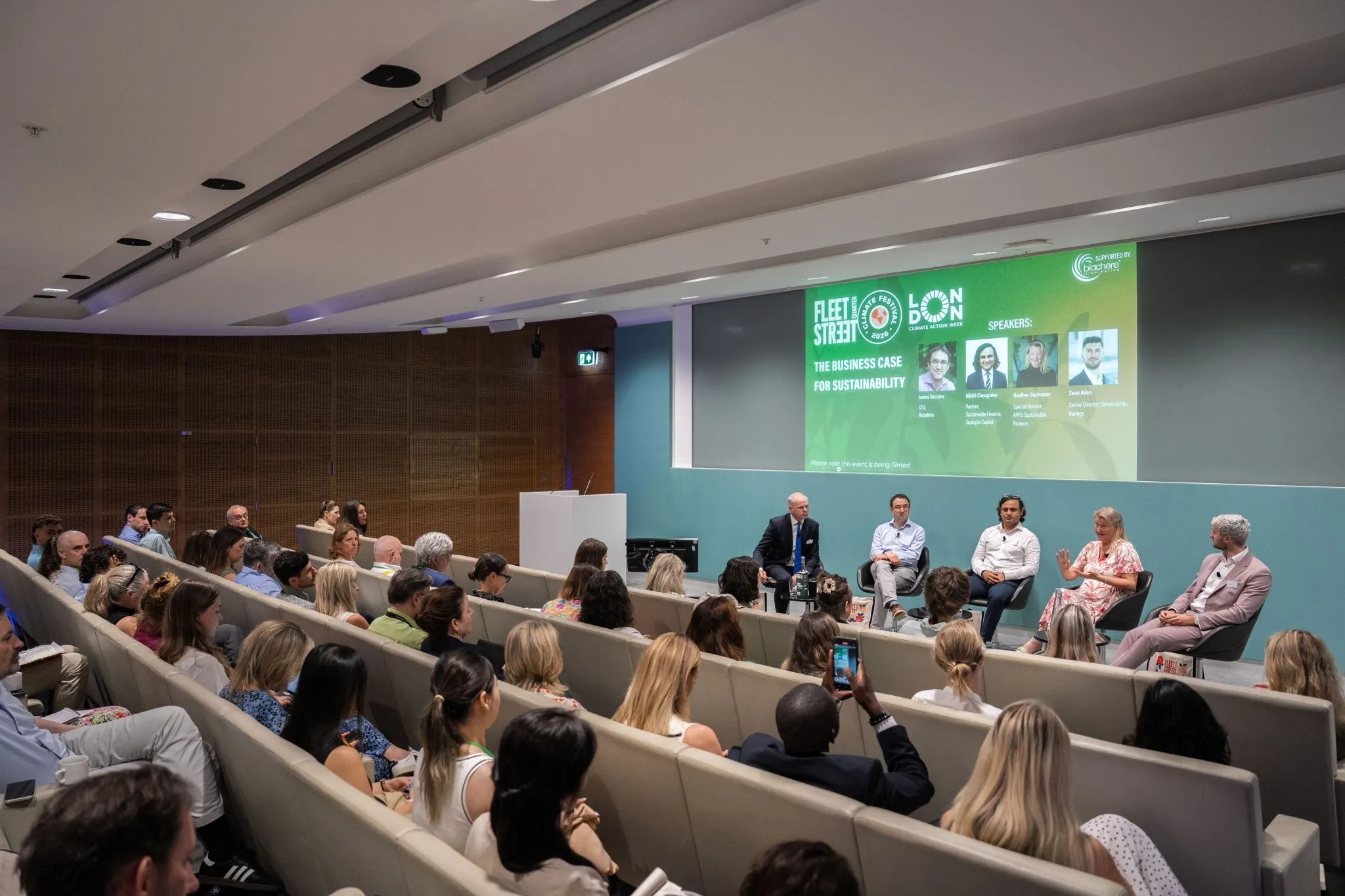
The Business Case for Sustainability
Hosts: Deloitte and Fleet Street Quarter
This was one of the few non-CDR specific events attended and was centered around "how can we build resilience in a world defined by insecurity and volatility?" Among some very inspiring and creative addresses (particularly from Sky News' Paul Kelso), one key remark stood out - 'recognising the value of sustainability' from Heather Buchanan from APPG Sustainable Finance. Oil was sat under the Middle East for thousands of years and the value was not recognised. Now its the most valuable commodity in human history. We're starting to acknowledge the value and putting it on the balance sheet.
What We Talk About When We Talk About VCM+: Communicating the Market’s Many Developments
Host: VCM+ Collaborative
The session utilised interactive group work focused on different themes to share knowledge and experience. Participants concluded that carbon market evolution is favoured over total reform, with improved methodologies now outpacing the outdated, risk-focused narrative. Key takeaways include treating markets as complementary tools requiring a diverse portfolio of removals and reductions, alongside re-engaging with stricter oversight rules. Key takeaway regarding buyers and project developers: Understand what drives buyer / investor interest by speaking their language. Communities and co-benefits are vital, but their exact importance varies depending on the specific organisation’s goals.And project developers must hone their messaging to communicate in a language that decision-makers understand.
Abatement of Methane Emissions in the Oil & Gas Sector: Costs and Opportunities
Hosts: Harvard, RMI and IETA
The Oil & Gas (O&G) sector faces a critical capital allocation choice: fund expensive, early-stage Carbon Dioxide Removal (CDR) or ruthlessly plug their own methane leaks. Because methane drives nearly half of near-term warming, optimising leakage has become an extremely strong contender to the immediate priority for 1.5°C targets, potentially stalling O&G demand for CDR.
In this session experts revealed that up to $20 billion in value is lost annually from leaking and flaring gas. Higher methane leaks leads to more risk and require tailored, specialised insurance policies to adequately protect your business. Higher gas prices naturally drive less methane leakage because the leaking gas represents lost revenue, creating a direct financial incentive for operators to capture and sell it. Education and awareness remain critical. Conclusion: Eliminating these emissions is a massive economic opportunity, with 70% of industry leaks fixable at low or no net cost using existing technology.
The 47% Leverage Point: Roughly 47% of global O&G emissions can be eliminated simply by capping upstream fugitive venting and leakage of methane. Operators already possess the engineering talent and infrastructure to do this; it requires no new external markets.
CDR2030: The Action Agenda for Growing Carbon Removal
Hosts: Chris Neidl and Counteract, supported by Bellona, WBCSD, The Group of Negative Emitters (GONE)
The event focused heavily on shifting from mid-century theory to a strict five year implementation. Dr. Steve Smith University of Oxford / CO2RE Hub set the stage presenting the data from the newly released 3rd Edition of theState Of CDR report. Main outcome: National climate pledges leave a massive 5 billion tonne shortfall per year by 2050 and to close this gap, novel CDR must scale at rates faster than the fastest clean energy transitions in human history. The CDR2030 initiative urges a five-year, actionable sprint to achieve 100 million tons of novel, durable carbon removal and 3 gigatonnes of nature-based solutions by 2030. This strategy focuses on a coordinated, near-term push across policy, finance, demand mobilisation, and industrial integration to shift from 2050 targets to immediate implementation.
1. The Macro Picture: Structural Realities & The CDR Gap
As outlined by Dr. Steve Smith (Executive Director of Oxford Net Zero and lead author of the State of CDR Report), the global deployment landscape is deeply fractured between two tiers of removal.
Total Global CDR (~2.22 Gt CO2/yr)
├── Conventional Land Sinks (99.9%): ~2.2 Gt CO2/yr (forests, mangroves)
└── Novel Technological CDR (0.1%): ~2 Mt CO2/yr (BECCS, DACCS, biochar, enhanced rock weathering)
While conventional land sinks do the near-term heavy lifting, IPCC models reveal they will get "old quickly," hitting strict land-use caps. To stabilise the climate and handle the projected 10% to 20% residual overshoot emissions, novel CDR must transition out of its formative phase and embark on a hyper-accelerated S-curve:
- Current Baseline: Novel CDR sits at a tiny ~2 Mt CO2/year (heavily dominated by biochar, which is growing at 40% year-on-year).
- The 2030 Target: The Action Agenda has pinned a target of 100 Mt of novel removals by 2030. Achieving this requires a near-impossible scale-up trajectory to bridge the gap before hitting multi-gigaton requirements by mid-century.
2. The Implementation Bottlenecks: Salience vs. Relevance
Chris Neidl framed the core problem not as a technology bottleneck, but as a dual mobilisation and implementation challenge.
ACCELERATION MATRIX
[ URGENCY ] ──► Real-world action over the next 5 years, not 30.
[ EVIDENCE ] ──► Verifiable data to eliminate greenwashing fears.
[ SALIENCE ] ──► Show visible breakthroughs (e.g., how solar scaled).
[ RELEVANCE ] ──► Embed CDR as an asset inside existing industrial stacks.
- The Relevance Solution: CDR must stop positioning itself as a standalone industry competing for climate funds. Instead, it must become a cross-cutting capability embedded into core development goals, existing heavy infrastructure, and industrial supply chains (e.g., curing concrete with permanent carbon storage).
- The Salience Deficit: Because CDR is highly diverse (ranging from deep geological injection to ocean alkalinity enhancement), the general public and corporate buyers struggle to grasp it as a "real-world pursuit." It lacks the visible, easily understood momentum that solar panels and wind turbines enjoyed during their early adoption phases.
3. The Rules Matrix: Carbon Accounting & Compliance
A major insight from the expert panel (featuring Delia Meth-Cohn of Rethinking Removals) is that corporate demand is completely paralysed by a structural gap in international standards.
The Corporate Catch-22: When speaking with Fortune 500 corporates, their climate teams state: "Nobody is forcing us to buy novel CDR, we cannot formally report it under current frameworks, so why would we spend shareholder capital on it?"
4. The Flux in Carbon Accounting Standards
If an action cannot be accounted for in standard ledger books, it remains corporate fiction. Historically, frameworks like the Greenhouse Gas Protocol (GHGP) and ISO/SBTi Net Zero Standards focused strictly on physical asset inventories (where a company only tracks what it directly emits or avoids).
- The Scope Blindspot: If an enterprise pays to remove carbon via an external provider, it completely disappears from their standard inventory sheets, making the transaction economically invisible.
- The Window of Opportunity: Over the next few months leading into COP, global standard-setting bodies are merging and completely revising their frameworks. The urgent goal of working groups is to transition these standards from pure physical inventories to interoperable frameworks that recognise value-chain removals and embedded product storage.
5. The Policy & Financing Blueprint
Relying on philanthropy and early-stage VC capital is no longer viable; a typical novel project requires $5M to $8M in pure upfront R&D risk capital just to establish it operationally. The Action Agenda focuses on activating distinct structural levers:
- Moving past voluntary, performative tokens toward sovereign-backed buying. Key demand-side anchors include the US 45Q tax credit, Japan’s GX (Green Transformation) policies, and direct compliance integration within the UK/EU ETS (Emissions Trading Schemes). However, national pledges (NDCs) from major economies are alarmingly decreasing their explicit CDR language.
- The priority is establishing foundational rule-making: multi-nation coalitions focused on standardised, coordinated MRV (Measurement, Reporting, and Verification) protocols, environmental safeguards, and legal liability tracking for permanent storage.
- Targeting "First-Of-A-Kind" (FOAK) engineering projects by partnering directly with heavy industry. This involves securing risk capital from innovation-forward funders rather than waiting on lagging government legislation, directly embedding removal assets into high-value infrastructure sectors like maritime shipping, zero-waste municipal planning, and heavy building materials.
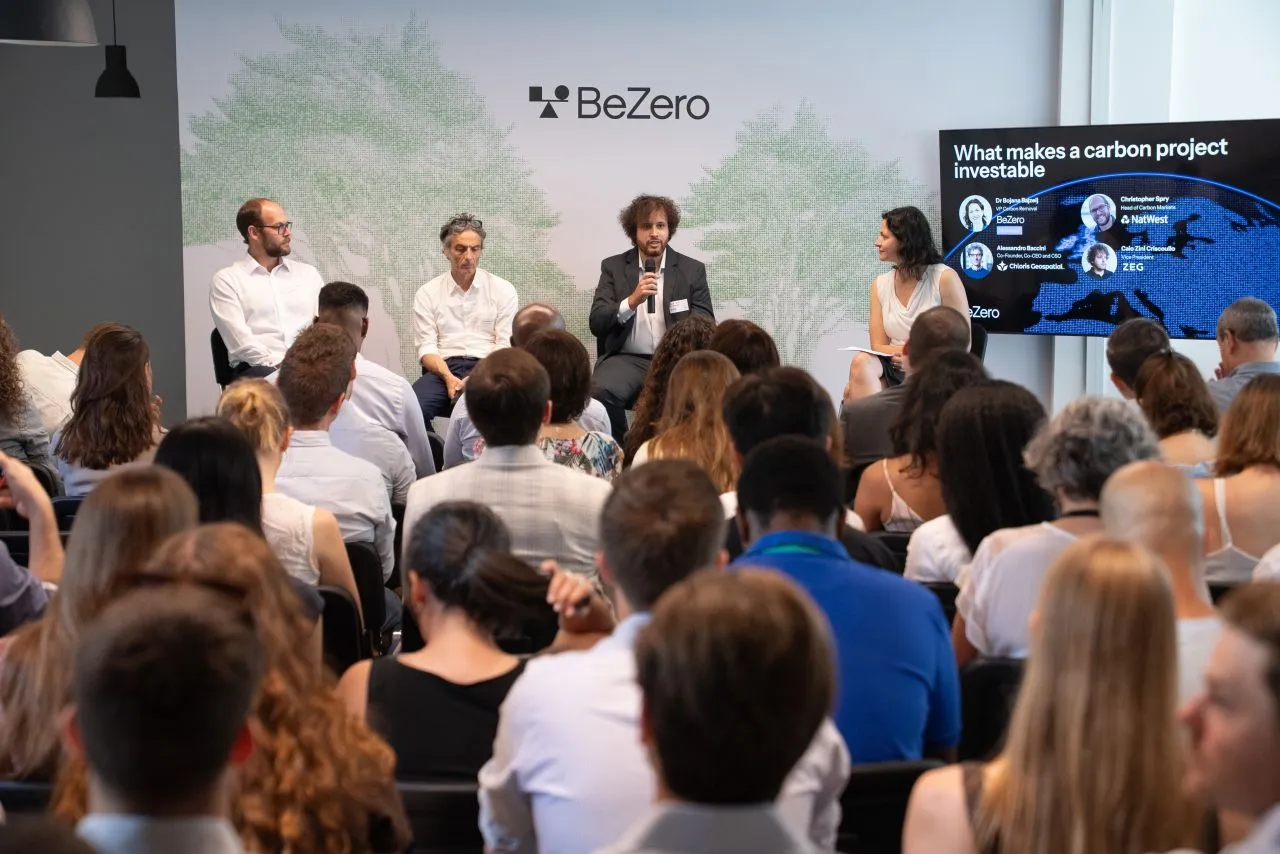
Intelligent Markets
Hosts: Bloomberg x BeZero Carbon
The convergence of AI and environmental markets (VCM, compliance ETS like EU/UK/California) represents a critical turning point. The industry is aggressively deploying AI to supercharge liquidity, solve structural transparency issues, and address what panelists called the "Trust Paradox."
1. The Carbon Market "Shadow Economy" & The Trust Paradox
Despite significant pricing and regulatory progress since 2020 via rating agencies and the Integrity Council for the Voluntary Carbon Market (ICVCM), the VCM suffers from a severe deficit of institutional trust:
- The Anonymity Problem: Currently, 65% of all carbon credits are retired completely anonymously at the registry level.
- Fear of Public Backlash: Corporate buyers, including major financial institutions purchasing premium, top-tier project derivatives, frequently omit these transactions from their corporate sustainability reports. They are simply terrified of being singled out or accused of greenwashing due to legacy market bad press.
- The Non-SBTi Demand Driver: Interestingly, companies not bound by strict SBTi targets (Science Based Targets initiative) purchase credits at twice the rate of SBTi-committed companies. Heavy emitters like Oil & Gas operators buy and openly declare them, whereas sectors like logistics frequently purchase them but refuse to claim them publicly.
2. High-Velocity Due Diligence via Multi-Agent AI
The VCM ecosystem is incredibly fragmented, burdened by over 400 distinct project methodologies and multiple conflicting rating agencies. Traditional project due diligence takes weeks or months per asset, a major barrier to institutional scaling.
To bring the friction, time, and monetary cost of transactions close to zero, platforms like BeZero, Patch, and Bloomberg are building a unified "Terminal of the Future" stack using multi-agent workflows.
- The Single-Pane Market View: AI agents ingest raw metadata from disparate geographical supply chains, verifying whether a project is 3rd-party endorsed, registered, or structurally sound.
- Standardising Co-Benefits: While carbon math is stabilising, measuring a project's UN Sustainable Development Goal (SDG) scores or local community impacts remains highly unstandardized. AI agents extract, map, and contextualize these qualitative "co-benefit" narratives out of thousands of pages of unstructured data.
- Cross-Sectional Data Blending: Advanced interfaces (such as Bloomberg's AskB tool) are actively working to break down silos, blending isolated carbon project registries directly with macroeconomic data, financial indicators, and asset manager trading logs.
3. The "Rubbish In, Rubbish Out" Guardrail & AI Limitations
While generative AI dramatically cuts down prototyping timelines, tech leaders emphasise creating clear technical and operational boundaries to avoid "false confidence."
- The SDG Data Integrity Gap: Relying blindly on automated data pulling can backfire. Panels noted cases where 99% of a project's reported algorithmic SDG data was flatly incorrect from old standards bodies.
- The Site-Visit Prerequisite: To avoid the "rubbish in, rubbish out" trap, platforms refuse to cut out gritty, bottom-up human engineering work. Complex ecological risk assessment still demands on-site physical field visits.
- The "Efficiently Inefficient" Method: To de-risk automated intelligence, data platforms construct multi-agent pipelines engineered to be "efficiently inefficient." Multiple software agents understand a legal or ecological requirement, translate it into software logic, and route it to a distinct QA control agent before a human analyst reviews it.
4. Shifting from Compliance Paperwork to Material Impact
The immediate value of AI in this ecosystem follows a classic S-curve adoption model. Initially, it acts as a massive efficiency lift for burdensome regulatory mandates (e.g., California’s AB1305, CSRD, and global climate disclosures).
The Compliance Inflection Point: Corporate sustainability teams historically spent an entire year compiling a single annual emissions report, entirely draining their operational capacity. Multi-agent workflows compress that data gathering and synthesis timeline down to one hour.
By shifting the heavy administrative lift to automated data pipelines, corporate teams can transition their focus away from defensive paperwork and toward active, material decarbonization strategy and portfolio risk management.
From Design to Investment: Building Carbon Projects That Scale
Hosts: BeZero
Scaling effective carbon removal projects by 2030 requires risk reduction through transparent ratings, scalable MRV data, and strict adherence to corporate compliance frameworks. Risk-averse buyers with small sustainability teams rely heavily on external validations like BeZero ratings to navigate complexities like land security and additionality. To attract these long-term corporate buyers, developers must provide high-quality projects aligned with the SBTi framework (SBTI North Star for corporates). Risk and cost management are optimised by combining expensive local field data with free, scalable satellite earth observations, creating reliable systems that build market trust.
Panel 1: What Makes a Carbon Project Investible
Effective carbon removal project scaling by 2030 requires risk reduction through transparent ratings, scalable MRV data, and strict adherence to corporate compliance frameworks. Risk-averse buyers with small sustainability teams rely heavily on external validations like BeZero ratings to navigate complexities like land security and additionality. To attract these long-term corporate buyers, developers must provide high-quality projects aligned with the SBTi framework. Risk and cost management are optimised by combining expensive local field data with free, scalable satellite earth observations, creating reliable systems that build market trust.
Panel 2: How Capital Actually Gets Deployed
Navigating the carbon market remains highly complex due to unpredictable corporate buyer behaviour, severe shortages of high-quality supply, and intense project evaluation barriers. While corporate buyers seek long-term investments and high-integrity credits to secure net-zero claims, fund managers must filter out a lot of opportunities to manage extreme project risks and avoid concentration issues. High-quality, high-rated credits are critically scarce and highly sought-after technologies like biochar sell out immediately, while blue carbon options remain rare and expensive. Consequently, evaluating complex carbon projects requires a strict balance of risk, return, and impact, driving investors toward diversified portfolios, vertical integration, and compliance frameworks like CORSIA. To overcome these hurdles, specific project ratings and direct developer engagement are becoming highly critical, as they provide the vital standardisation needed to build market liquidity and reduce overall investment risk.
Building What’s Next in Carbon Markets
Hosts: Verra, Xpansiv and S&P Global
Panel 1: Leader Panel: The Future of Carbon Market Infrastructure
The carbon market is currently undergoing a structural reset as it transitions away from paralysing perfectionism toward scalable digital infrastructure that drives cross-border capital to the Global South. While carbon financing cannot replace absolute decarbonisation, building a trusted market requires replacing messy, manual processes with unified international registries that cut transaction costs and boost transparency. Rather than letting over-regulation stall immediate progress, the industry must invest heavily in data infrastructure to achieve the speed and scale required to meet climate targets. Furthermore, overcoming the market’s severe public relations problem depends on broad education and directly bringing skeptical corporate leaders to project sites to rebuild foundational trust in the system. "You can take a horse to water, but can’t make it drink."
Panel 2: Technical Deep Dive: Building the Market’s Digital Backbone
Key takeaways emphasise that unifying data standards is essential to meet growing global compliance demands while maintaining high data integrity and human accountability. This market growth will be managed through streamlined digital verification that drastically shortens project approval timelines, complementing on-the-ground auditing while dismantling fragmented, country-specific data models in favour of unified frameworks like Singapore’s registry model. Over the next five years, major standard setters like Verra plan to transition all methodologies and standards from slow, manual processes to full digital automation. However, as the market scales through these automated ecosystems, the industry must strictly define the boundaries where software increases transaction speed and where human oversight remains legally necessary to maintain clear accountability.
CDR in the Global South - Real Stories from Real Entrepreneurs
Hosts: remove, Nextgen, CBC
Investment in Global South carbon dioxide removal drives local economic growth and community empowerment, offering a massive future market opportunity despite currently low deployment. To unlock this potential, blended finance is critical to overcome high capital costs, while project success relies on optimising regional supply chains, establishing robust MRV systems, and deploying scalable near-term tech like biochar and enhanced weathering. Although corporate buyers prioritise project quality and strict due diligence over location, integrating deep community co-benefits directly lowers project execution risk. Ultimately, keeping the Voluntary Carbon Market active while local compliance regulations catch up ensures that economic value and financial windfalls are meaningfully retained within host countries.

Climeworks Executive Breakfast – What's Next for Corporate Net Zero
Host: Climeworks
The morning session was a very impressive collection of corporate sustainability leaders and CDR professionals. The main talking points of the session touched upon the impacts of SBTi's new Corporate Net Zero Standard and how corporate leaders like TikTok, Klarna and Deloitte are integrating carbon removal into their strategies. One particular mention was TikTok's Global Head of Sustainability, Ian Gill, highlighting that the push for them is advertising preferences. Customers are choosing platforms that align with their own personal views, and sustainable practices are increasingly playing a large part in deciding where they spend their money. This is something that was heard across the week - whilst there isn't a single driver or reason why corporate companies are voluntarily purchasing CDR, one of the biggest drivers is clients and/ or employees driving this push by voting with their pounds [£] and time.
London Climate Action Week 2026
London Climate Action Week has grown into a behemoth of a meeting, becoming the 2nd largest climate week after New York with over 100,000 attendees. It's a migration of climate professionals, flocking from all over the world to England’s capital for a week of 1000s of free-to-attend and closed-door meetings put on by all sorts of companies and organisations. Even those not focused on climate are being drawn into its orbit as it starts to affect every industry and corner of the globe. We felt this as temperatures rose to 40 degrees across London.
Just comparing it to the year prior, the number of CDR-focused events and onstage mentions had notably increased. More fringe topics within the removals sphere, like methane abatement, had dedicated events with strong attendance. Among the backdrop of the current political, economic and industry-specific pessimism, it is easy to feel like we’re moving backwards. But gatherings like these bring a sense of grounded realism and remind us of the progress being made. Some, of course, can be echo chambers, but others stimulate thoughtful debate and push those on both extremes to come away with different perspectives. If nothing else, these climate weeks illustrate one thing; there are 100,000s of intelligent and diligent individuals working on solving this problem. Things aren’t always moving quick enough, but they are moving in the right direction.
June and July acts as a short ‘break’ from the Carbon Unbound event calendar before the pressure of delivering Europe sets in (although some of the team may not agree). The company took our chance to take off our organiser hats and enjoy just being attendees. To the event organisers, those who we saw hurrying across venue stages and exhibition floors with a calm facade, feeling the rising stress of finding the next speaker or making sure the reception break was running on time, we salute you.
We’ve compiled the team’s takeaways from hours of sessions and interactions. For those that are looking for their next CDR event, we invite you to Carbon Unbound Europe in October to reconnect and share progress.
Summarised takeaways
(Event summaries below)
Policy & Compliance
- EU ETS review lands 15 July. One of the key design questions is centralised buyer intermediary vs. direct procurement.
- Political momentum can reverse overnight, as seen in the US DAC hub u-turn. Don't plan around policy permanence.
- The threat of regulation moves markets more than regulation itself. NYC's Local Law 97 reshaped real estate before it even bit.
Market Dynamics
- Quality is beating price. Average CDR cost targets have tripled by surveyed buyers since 2022.
- Portfolio approaches are winning over single-pathway bets. This spreads both cost and risk.
- High-quality credits are scarce and selling out fast. Biochar leads the pack, while blue carbon remains rare and pricey.
- 65% of credits are retired anonymously. Trust, not supply, is the market's real constraint.
- Non-SBTi companies buy CDR at 2x the rate of SBTi companies. They just talk about it less.
The Accounting Bottleneck
- Novel CDR is still just 0.1% of global removals. The gap to 100Mt by 2030 demands a steeper scale-up than any past clean energy transition.
- Most corporates can't formally report novel CDR purchases under current frameworks. So the spend stays invisible on the balance sheet.
- Standards are being rewritten now, ahead of COP. This is a live window to shift from physical inventories to value-chain recognition.
AI & Infrastructure
- Multi-agent AI is collapsing due diligence timelines from weeks to real-time.
- "Rubbish in, rubbish out" still holds. Automated data pulls still need human site visits to catch bad inputs.
- What used to take a year (a single emissions report) now takes about an hour.
Corporate Demand Drivers
- Frame CDR as risk management, not idealism. Insurance premiums and regulatory exposure are the language CFOs respond to.
- Employees, not investors, are the loudest internal voice pushing corporate CDR spend.
- Watch what CEOs do, not what they say. "Green hushing" is increasingly the norm.
- Advertising preference is a hidden driver. TikTok's sustainability lead noted that consumers choosing platforms by values is quietly shaping corporate strategy.
Global South & Methane
- Blended finance, not goodwill, is what unlocks Global South CDR. Community co-benefits actively de-risk projects.
- Methane is O&G's cheaper first move. Roughly 47% of sector emissions could be cut just by fixing leaks.
- $20bn/year is lost to leaking and flaring gas. 70% of those leaks are fixable at low or no cost.
Event Summaries
Carbon Removal London 2026
Hosts: Supercritical, supported by Cula Technologies, Puro.earth, Negative Emissions Platform, Carbon Business Council, Charm, InPlanet, Stockholm Exergi
1. Compliance is coming. Are you ready?
This was a deeply interesting and informing panel between Chris Sherwood (Negative Emissions Platform), Dr. Mai Bui (Supercritical), Sarju Patel (DESNEZ) and Bloomberg's Lara Williams. The conversation (obviously) centered around the policy mechanisms that are shaping the future of demand and supply, with a strong focus on the European Commission's legislative proposal to review and revise the EU ETS on 15th July. One really important aspect of this will be their 'design choice' of how companies can procure. One option is integrating an EU buyer intermediary who vetted and purchases a portfolio, which is then available to purchase. This would mean there would be a centralised way of buying CDRs that has gone through diligence. Essentially, the role of marketplaces and brokers in the private sector.
Another important mention here was the fact that the 'political process is not a given', as seen in the US recently with the u-turn on DAC hubs and the Infrastructure Bill from Biden's administration. The industry is waiting on baited breath for announcements around ETS and other compliance mechanisms, but in a moment's notice political priorities could change which scuppers plans.
Finally, the main takeaway from Sarju was 'don't stop the activity.' The transition to cheaper credits is only going to happen if we're starting today. This has been an echoing statement over the past few years and was promising to hear a senior government official speaking about this publically.
2. Is $100/tonne a myth?
BCG's Bayo Owolabi presented their findings of their CDR pricing survey across the last 4 years. The biggest stand out here was the evidence of market paying more for quality, as average cost targets have tripled since 2022. This is underpinned by the responses of their first survey, where companies said they would pay more if project criteria ticks all the boxes for quality. That has been proven to be true and so its being shown that quality trumps price (within reason).
It also underlined the shift from a focus on one CDR pathway, to a portfolio approach that brings cost down and also reduces risk. Finally, as super pollutants commands more attention, it was shown that the gap between pricing is stark. $10 average super pollutant credit vs over $100 for CDR. The question of whether super pollutants will divert capital from CDR remains to be seen, albeit probably obviously, and a portfolio approach to including these credits would likely be advantageous from a pricing, impact and risk perspective.
3. What does biochar look like in 2035?
This discussion with biochar experts from Puro.earth, Cula, Supercritical and Exomad Green spanned cost dynamics scaling strategies, demand and insetting as well as finance. A few key insights that stood out;
- Cost dynamics: Input costs (fuel, labour, biomass) likely to rise; technology improvements may offset but not reverse prices. Expect biochar credit pricing to be broadly stable to rising, with more impact from cost management than price declines.
- Scaling strategy: Leverage both centralized high-volume plants and distributed industrial models tapping decentralized agricultural residues; standardised, scalable equipment manufacturing is needed to unlock economies of scale.
- Artisanal vs industrial: Consensus that artisanal biochar will decline by 2035; industrial production - centralized and distributed - will dominate to ensure measurability, repeatability, and quality control.
- Biochar is a strong insetting tool for sectors with agricultural value chains (food & beverage, fashion, construction), but not universally accessible. There is growing cross-industry potential for biochar as a material input; credits increasingly treated as commodities, with social licence embedded.
- Unlocking tens of billions in CAPEX requires long-term offtake agreements, asset/debt financing, and creative bank participation (credit plus debt structures). Buyers’ long-term commitments are pivotal to trigger project financing.
4. Does carbon removal survive the headwinds?
The onstage content culminated in a fireside with JLL, a property services company who manages buildings for companies like HSBC, Google and Amazon. Their Head of Sustainability Guy Grainger noted that;
- "the threat of regulation is often more catalytic than regulation itself". He noted New York's Local Law 97 that fines buildings based on carbon emissions, which has completely changed the market in that city.
- Our leadership mix matters. Don’t just look at targets; look at what the CEO says and does. JP Morgan is doing interesting work - Jamie Dimon doesn’t talk about it much, but you can see it in their sustainability report. In the US, saying too much publicly isn’t worth the hassle. Watch what companies do. JLL is New York-listed with a roughly $13 billion market cap, and we have a German CEO - he thinks differently to a Texan CEO. Leadership signals matter.
- Quiet action beats loud over claiming; employee expectations - especially around tech and AI - are shaping corporate behaviour. Green hushing is better than the previous wave of lying. Companies will be judged by what they do—and judged most by their employees. "For us, our 110,000 employees are the biggest stakeholder in our climate targets. It’s not investors. It’s only partly clients. This isn’t customer-driven, it’s driven by people wanting to work for a responsible company."
- For carbon removal, we must frame it as risk management. Every business leader is paranoid about risk; enterprise risk lists have gone through the roof. Physical climate risk is on there. Power is on there. The advantage of removing carbon must be articulated in dollars - insurance premiums, regulatory exposure, the threat of regulation. Even that threat is enough to quantify.
The Business Case for Sustainability
Hosts: Deloitte and Fleet Street Quarter
This was one of the few non-CDR specific events attended and was centered around "how can we build resilience in a world defined by insecurity and volatility?" Among some very inspiring and creative addresses (particularly from Sky News' Paul Kelso), one key remark stood out - 'recognising the value of sustainability' from Heather Buchanan from APPG Sustainable Finance. Oil was sat under the Middle East for thousands of years and the value was not recognised. Now its the most valuable commodity in human history. We're starting to acknowledge the value and putting it on the balance sheet.
What We Talk About When We Talk About VCM+: Communicating the Market’s Many Developments
Host: VCM+ Collaborative
The session utilised interactive group work focused on different themes to share knowledge and experience. Participants concluded that carbon market evolution is favoured over total reform, with improved methodologies now outpacing the outdated, risk-focused narrative. Key takeaways include treating markets as complementary tools requiring a diverse portfolio of removals and reductions, alongside re-engaging with stricter oversight rules. Key takeaway regarding buyers and project developers: Understand what drives buyer / investor interest by speaking their language. Communities and co-benefits are vital, but their exact importance varies depending on the specific organisation’s goals.And project developers must hone their messaging to communicate in a language that decision-makers understand.
Abatement of Methane Emissions in the Oil & Gas Sector: Costs and Opportunities
Hosts: Harvard, RMI and IETA
The Oil & Gas (O&G) sector faces a critical capital allocation choice: fund expensive, early-stage Carbon Dioxide Removal (CDR) or ruthlessly plug their own methane leaks. Because methane drives nearly half of near-term warming, optimising leakage has become an extremely strong contender to the immediate priority for 1.5°C targets, potentially stalling O&G demand for CDR.
In this session experts revealed that up to $20 billion in value is lost annually from leaking and flaring gas. Higher methane leaks leads to more risk and require tailored, specialised insurance policies to adequately protect your business. Higher gas prices naturally drive less methane leakage because the leaking gas represents lost revenue, creating a direct financial incentive for operators to capture and sell it. Education and awareness remain critical. Conclusion: Eliminating these emissions is a massive economic opportunity, with 70% of industry leaks fixable at low or no net cost using existing technology.
The 47% Leverage Point: Roughly 47% of global O&G emissions can be eliminated simply by capping upstream fugitive venting and leakage of methane. Operators already possess the engineering talent and infrastructure to do this; it requires no new external markets.
CDR2030: The Action Agenda for Growing Carbon Removal
Hosts: Chris Neidl and Counteract, supported by Bellona, WBCSD, The Group of Negative Emitters (GONE)
The event focused heavily on shifting from mid-century theory to a strict five year implementation. Dr. Steve Smith University of Oxford / CO2RE Hub set the stage presenting the data from the newly released 3rd Edition of theState Of CDR report. Main outcome: National climate pledges leave a massive 5 billion tonne shortfall per year by 2050 and to close this gap, novel CDR must scale at rates faster than the fastest clean energy transitions in human history. The CDR2030 initiative urges a five-year, actionable sprint to achieve 100 million tons of novel, durable carbon removal and 3 gigatonnes of nature-based solutions by 2030. This strategy focuses on a coordinated, near-term push across policy, finance, demand mobilisation, and industrial integration to shift from 2050 targets to immediate implementation.
1. The Macro Picture: Structural Realities & The CDR Gap
As outlined by Dr. Steve Smith (Executive Director of Oxford Net Zero and lead author of the State of CDR Report), the global deployment landscape is deeply fractured between two tiers of removal.
Total Global CDR (~2.22 Gt CO2/yr)
├── Conventional Land Sinks (99.9%): ~2.2 Gt CO2/yr (forests, mangroves)
└── Novel Technological CDR (0.1%): ~2 Mt CO2/yr (BECCS, DACCS, biochar, enhanced rock weathering)
While conventional land sinks do the near-term heavy lifting, IPCC models reveal they will get "old quickly," hitting strict land-use caps. To stabilise the climate and handle the projected 10% to 20% residual overshoot emissions, novel CDR must transition out of its formative phase and embark on a hyper-accelerated S-curve:
- Current Baseline: Novel CDR sits at a tiny ~2 Mt CO2/year (heavily dominated by biochar, which is growing at 40% year-on-year).
- The 2030 Target: The Action Agenda has pinned a target of 100 Mt of novel removals by 2030. Achieving this requires a near-impossible scale-up trajectory to bridge the gap before hitting multi-gigaton requirements by mid-century.
2. The Implementation Bottlenecks: Salience vs. Relevance
Chris Neidl framed the core problem not as a technology bottleneck, but as a dual mobilisation and implementation challenge.
ACCELERATION MATRIX
[ URGENCY ] ──► Real-world action over the next 5 years, not 30.
[ EVIDENCE ] ──► Verifiable data to eliminate greenwashing fears.
[ SALIENCE ] ──► Show visible breakthroughs (e.g., how solar scaled).
[ RELEVANCE ] ──► Embed CDR as an asset inside existing industrial stacks.
- The Relevance Solution: CDR must stop positioning itself as a standalone industry competing for climate funds. Instead, it must become a cross-cutting capability embedded into core development goals, existing heavy infrastructure, and industrial supply chains (e.g., curing concrete with permanent carbon storage).
- The Salience Deficit: Because CDR is highly diverse (ranging from deep geological injection to ocean alkalinity enhancement), the general public and corporate buyers struggle to grasp it as a "real-world pursuit." It lacks the visible, easily understood momentum that solar panels and wind turbines enjoyed during their early adoption phases.
3. The Rules Matrix: Carbon Accounting & Compliance
A major insight from the expert panel (featuring Delia Meth-Cohn of Rethinking Removals) is that corporate demand is completely paralysed by a structural gap in international standards.
The Corporate Catch-22: When speaking with Fortune 500 corporates, their climate teams state: "Nobody is forcing us to buy novel CDR, we cannot formally report it under current frameworks, so why would we spend shareholder capital on it?"
4. The Flux in Carbon Accounting Standards
If an action cannot be accounted for in standard ledger books, it remains corporate fiction. Historically, frameworks like the Greenhouse Gas Protocol (GHGP) and ISO/SBTi Net Zero Standards focused strictly on physical asset inventories (where a company only tracks what it directly emits or avoids).
- The Scope Blindspot: If an enterprise pays to remove carbon via an external provider, it completely disappears from their standard inventory sheets, making the transaction economically invisible.
- The Window of Opportunity: Over the next few months leading into COP, global standard-setting bodies are merging and completely revising their frameworks. The urgent goal of working groups is to transition these standards from pure physical inventories to interoperable frameworks that recognise value-chain removals and embedded product storage.
5. The Policy & Financing Blueprint
Relying on philanthropy and early-stage VC capital is no longer viable; a typical novel project requires $5M to $8M in pure upfront R&D risk capital just to establish it operationally. The Action Agenda focuses on activating distinct structural levers:
- Moving past voluntary, performative tokens toward sovereign-backed buying. Key demand-side anchors include the US 45Q tax credit, Japan’s GX (Green Transformation) policies, and direct compliance integration within the UK/EU ETS (Emissions Trading Schemes). However, national pledges (NDCs) from major economies are alarmingly decreasing their explicit CDR language.
- The priority is establishing foundational rule-making: multi-nation coalitions focused on standardised, coordinated MRV (Measurement, Reporting, and Verification) protocols, environmental safeguards, and legal liability tracking for permanent storage.
- Targeting "First-Of-A-Kind" (FOAK) engineering projects by partnering directly with heavy industry. This involves securing risk capital from innovation-forward funders rather than waiting on lagging government legislation, directly embedding removal assets into high-value infrastructure sectors like maritime shipping, zero-waste municipal planning, and heavy building materials.
Intelligent Markets
Hosts: Bloomberg x BeZero Carbon
The convergence of AI and environmental markets (VCM, compliance ETS like EU/UK/California) represents a critical turning point. The industry is aggressively deploying AI to supercharge liquidity, solve structural transparency issues, and address what panelists called the "Trust Paradox."
1. The Carbon Market "Shadow Economy" & The Trust Paradox
Despite significant pricing and regulatory progress since 2020 via rating agencies and the Integrity Council for the Voluntary Carbon Market (ICVCM), the VCM suffers from a severe deficit of institutional trust:
- The Anonymity Problem: Currently, 65% of all carbon credits are retired completely anonymously at the registry level.
- Fear of Public Backlash: Corporate buyers, including major financial institutions purchasing premium, top-tier project derivatives, frequently omit these transactions from their corporate sustainability reports. They are simply terrified of being singled out or accused of greenwashing due to legacy market bad press.
- The Non-SBTi Demand Driver: Interestingly, companies not bound by strict SBTi targets (Science Based Targets initiative) purchase credits at twice the rate of SBTi-committed companies. Heavy emitters like Oil & Gas operators buy and openly declare them, whereas sectors like logistics frequently purchase them but refuse to claim them publicly.
2. High-Velocity Due Diligence via Multi-Agent AI
The VCM ecosystem is incredibly fragmented, burdened by over 400 distinct project methodologies and multiple conflicting rating agencies. Traditional project due diligence takes weeks or months per asset, a major barrier to institutional scaling.
To bring the friction, time, and monetary cost of transactions close to zero, platforms like BeZero, Patch, and Bloomberg are building a unified "Terminal of the Future" stack using multi-agent workflows.
- The Single-Pane Market View: AI agents ingest raw metadata from disparate geographical supply chains, verifying whether a project is 3rd-party endorsed, registered, or structurally sound.
- Standardising Co-Benefits: While carbon math is stabilising, measuring a project's UN Sustainable Development Goal (SDG) scores or local community impacts remains highly unstandardized. AI agents extract, map, and contextualize these qualitative "co-benefit" narratives out of thousands of pages of unstructured data.
- Cross-Sectional Data Blending: Advanced interfaces (such as Bloomberg's AskB tool) are actively working to break down silos, blending isolated carbon project registries directly with macroeconomic data, financial indicators, and asset manager trading logs.
3. The "Rubbish In, Rubbish Out" Guardrail & AI Limitations
While generative AI dramatically cuts down prototyping timelines, tech leaders emphasise creating clear technical and operational boundaries to avoid "false confidence."
- The SDG Data Integrity Gap: Relying blindly on automated data pulling can backfire. Panels noted cases where 99% of a project's reported algorithmic SDG data was flatly incorrect from old standards bodies.
- The Site-Visit Prerequisite: To avoid the "rubbish in, rubbish out" trap, platforms refuse to cut out gritty, bottom-up human engineering work. Complex ecological risk assessment still demands on-site physical field visits.
- The "Efficiently Inefficient" Method: To de-risk automated intelligence, data platforms construct multi-agent pipelines engineered to be "efficiently inefficient." Multiple software agents understand a legal or ecological requirement, translate it into software logic, and route it to a distinct QA control agent before a human analyst reviews it.
4. Shifting from Compliance Paperwork to Material Impact
The immediate value of AI in this ecosystem follows a classic S-curve adoption model. Initially, it acts as a massive efficiency lift for burdensome regulatory mandates (e.g., California’s AB1305, CSRD, and global climate disclosures).
The Compliance Inflection Point: Corporate sustainability teams historically spent an entire year compiling a single annual emissions report, entirely draining their operational capacity. Multi-agent workflows compress that data gathering and synthesis timeline down to one hour.
By shifting the heavy administrative lift to automated data pipelines, corporate teams can transition their focus away from defensive paperwork and toward active, material decarbonization strategy and portfolio risk management.
From Design to Investment: Building Carbon Projects That Scale
Hosts: BeZero
Scaling effective carbon removal projects by 2030 requires risk reduction through transparent ratings, scalable MRV data, and strict adherence to corporate compliance frameworks. Risk-averse buyers with small sustainability teams rely heavily on external validations like BeZero ratings to navigate complexities like land security and additionality. To attract these long-term corporate buyers, developers must provide high-quality projects aligned with the SBTi framework (SBTI North Star for corporates). Risk and cost management are optimised by combining expensive local field data with free, scalable satellite earth observations, creating reliable systems that build market trust.
Panel 1: What Makes a Carbon Project Investible
Effective carbon removal project scaling by 2030 requires risk reduction through transparent ratings, scalable MRV data, and strict adherence to corporate compliance frameworks. Risk-averse buyers with small sustainability teams rely heavily on external validations like BeZero ratings to navigate complexities like land security and additionality. To attract these long-term corporate buyers, developers must provide high-quality projects aligned with the SBTi framework. Risk and cost management are optimised by combining expensive local field data with free, scalable satellite earth observations, creating reliable systems that build market trust.
Panel 2: How Capital Actually Gets Deployed
Navigating the carbon market remains highly complex due to unpredictable corporate buyer behaviour, severe shortages of high-quality supply, and intense project evaluation barriers. While corporate buyers seek long-term investments and high-integrity credits to secure net-zero claims, fund managers must filter out a lot of opportunities to manage extreme project risks and avoid concentration issues. High-quality, high-rated credits are critically scarce and highly sought-after technologies like biochar sell out immediately, while blue carbon options remain rare and expensive. Consequently, evaluating complex carbon projects requires a strict balance of risk, return, and impact, driving investors toward diversified portfolios, vertical integration, and compliance frameworks like CORSIA. To overcome these hurdles, specific project ratings and direct developer engagement are becoming highly critical, as they provide the vital standardisation needed to build market liquidity and reduce overall investment risk.
Building What’s Next in Carbon Markets
Hosts: Verra, Xpansiv and S&P Global
Panel 1: Leader Panel: The Future of Carbon Market Infrastructure
The carbon market is currently undergoing a structural reset as it transitions away from paralysing perfectionism toward scalable digital infrastructure that drives cross-border capital to the Global South. While carbon financing cannot replace absolute decarbonisation, building a trusted market requires replacing messy, manual processes with unified international registries that cut transaction costs and boost transparency. Rather than letting over-regulation stall immediate progress, the industry must invest heavily in data infrastructure to achieve the speed and scale required to meet climate targets. Furthermore, overcoming the market’s severe public relations problem depends on broad education and directly bringing skeptical corporate leaders to project sites to rebuild foundational trust in the system. "You can take a horse to water, but can’t make it drink."
Panel 2: Technical Deep Dive: Building the Market’s Digital Backbone
Key takeaways emphasise that unifying data standards is essential to meet growing global compliance demands while maintaining high data integrity and human accountability. This market growth will be managed through streamlined digital verification that drastically shortens project approval timelines, complementing on-the-ground auditing while dismantling fragmented, country-specific data models in favour of unified frameworks like Singapore’s registry model. Over the next five years, major standard setters like Verra plan to transition all methodologies and standards from slow, manual processes to full digital automation. However, as the market scales through these automated ecosystems, the industry must strictly define the boundaries where software increases transaction speed and where human oversight remains legally necessary to maintain clear accountability.
CDR in the Global South - Real Stories from Real Entrepreneurs
Hosts: remove, Nextgen, CBC
Investment in Global South carbon dioxide removal drives local economic growth and community empowerment, offering a massive future market opportunity despite currently low deployment. To unlock this potential, blended finance is critical to overcome high capital costs, while project success relies on optimising regional supply chains, establishing robust MRV systems, and deploying scalable near-term tech like biochar and enhanced weathering. Although corporate buyers prioritise project quality and strict due diligence over location, integrating deep community co-benefits directly lowers project execution risk. Ultimately, keeping the Voluntary Carbon Market active while local compliance regulations catch up ensures that economic value and financial windfalls are meaningfully retained within host countries.
Climeworks Executive Breakfast – What's Next for Corporate Net Zero
Host: Climeworks
The morning session was a very impressive collection of corporate sustainability leaders and CDR professionals. The main talking points of the session touched upon the impacts of SBTi's new Corporate Net Zero Standard and how corporate leaders like TikTok, Klarna and Deloitte are integrating carbon removal into their strategies. One particular mention was TikTok's Global Head of Sustainability, Ian Gill, highlighting that the push for them is advertising preferences. Customers are choosing platforms that align with their own personal views, and sustainable practices are increasingly playing a large part in deciding where they spend their money. This is something that was heard across the week - whilst there isn't a single driver or reason why corporate companies are voluntarily purchasing CDR, one of the biggest drivers is clients and/ or employees driving this push by voting with their pounds [£] and time.
.webp)
.webp)
.webp)
.webp)
.png)
.png)

.webp)